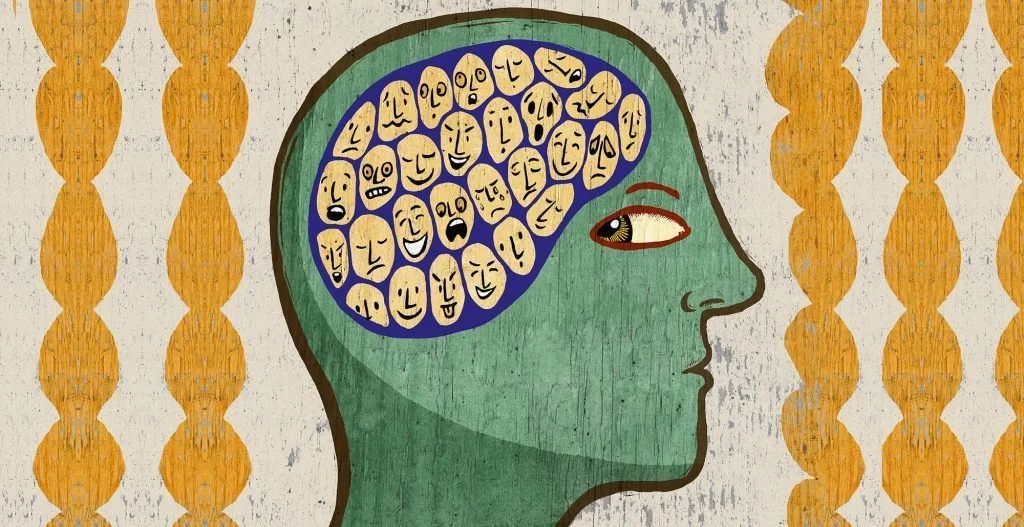
Why the different voices inside you aren't a problem to fix — and what to do with them instead.
Have you ever felt completely torn — like one part of you desperately wants to make a change, and another part won't let you?
Or maybe you've noticed an inner voice that shows up with harsh opinions about who you are, what you've done, or whether you're enough. Or a part of you that shuts down entirely when things feel like too much, even when you wish you could just stay present.
If any of that sounds familiar — that's not you being broken. That's actually you being human.
Every one of us has an inner world made up of different "parts," each with its own perspective, feelings, and way of trying to help. Learning to understand and relate to those parts is the heart of what we call parts work — and it can be one of the most quietly transformative things you do in therapy.
What Is Parts Work, Exactly?
Parts work is a therapeutic approach rooted in the idea that the mind is not a single, unified thing — it's more like an inner community. Different parts of us developed at different times, often in response to difficult experiences, and each one carries its own beliefs, fears, and strategies for keeping us safe.
The most well-known framework for parts work is Internal Family Systems (IFS), developed by Dr. Richard Schwartz. IFS views the psyche as a kind of internal family — a system of subpersonalities that interact with each other, sometimes harmoniously and sometimes in conflict. The goal isn't to get rid of any part, but to help all of them feel less burdened, less extreme, and more connected to what IFS calls the Self — your calm, compassionate core.
IFS was listed on the National Registry of Evidence-Based Programs and Practices in 2015, and a 2025 scoping review in Clinical Psychologist analyzed 27 peer-reviewed studies and identified IFS as a promising treatment, particularly for chronic pain, depression, and PTSD.
In my own practice, I draw from IFS alongside other parts-based frameworks — including inner child work and Lifespan Integration — depending on what a client needs. The specific model matters less than the underlying premise: that your inner world deserves curiosity, not judgment.
The Main Types of Parts
IFS identifies a few common categories of parts that most people recognize once they start paying attention. You don't need to memorize the labels — but they can be a helpful map.
Exiles are the youngest, most vulnerable parts. They carry the original wounds — the hurt, the shame, the grief, the beliefs that got formed early on: I'm too much. I'm not lovable. I'm not safe. These parts often get pushed down and hidden away because what they carry feels unbearable.
Managers are the proactive protectors. They show up early, trying to prevent the exile's pain from ever being triggered in the first place. This might look like perfectionism, people-pleasing, constant busyness, hypervigilance, or a relentless inner critic keeping you "in line." Managers aren't mean — they're scared. They learned a long time ago that if they could just control enough, stay small enough, achieve enough, the pain wouldn't get through.
Firefighters are the reactive protectors. When an exile does get triggered and the pain floods in anyway, firefighters rush in to put the fire out — fast. This might look like zoning out, reaching for a drink, binge-watching, rage, or anything else that creates immediate distance from an unbearable feeling. Like managers, firefighters aren't the enemy. They're doing their best with a very difficult job.
And then there's the Self — which isn't a part at all. It's your core. In IFS, the Self is characterized by non-judgment and qualities like mindfulness, patience, compassion, and curiosity. It's the part of you that can hold all the others with care — without becoming them. Most people have more access to their Self than they realize. Parts work is largely the process of helping the other parts trust it enough to step back.
The Goal Is Never to Get Rid of Any Part
This is one of the most important things I want people to understand about parts work — and it's one of the things that makes it feel so different from other approaches.
We are not in here trying to silence your inner critic, eliminate your anxiety, or cut off the part of you that shuts down. Those parts developed for a reason. Even the harshest manager parts often have a desperate, exhausted quality — they're not just achieving, they're earning the right to exist. They've been working incredibly hard, often since childhood, trying to keep you okay.
When we approach those parts with genuine curiosity instead of frustration — what are you afraid would happen if you stopped? what are you trying to protect? — something shifts. Parts that have been rigid and loud for years start to soften. Not because we forced them to, but because they finally felt seen.
That's the work.
What Might Come Up in Parts Work
As you begin to slow down and turn inward, you might start noticing things you hadn't quite put language to before. A few common experiences:
Recognizing that your inner critic isn't you — it's a part that's trying (clumsily) to protect you
Feeling grief for a younger version of yourself who had to carry something alone
Noticing the internal tug-of-war between a part that wants connection and a part that's terrified of it
Realizing that a pattern you've hated about yourself actually makes complete sense given what you went through
Beginning to feel genuine compassion for yourself — not as a concept, but as something real
Parts work can be especially helpful if you're navigating childhood trauma or attachment wounds, anxiety and inner conflict, patterns that feel impossible to break, or a sense that there are "different sides" of you pulling in opposite directions.
What Does Parts Work Actually Look Like in a Session?
It's more gentle than people often expect. We're not summoning anything dramatic. We're slowing down enough to notice — and then getting curious about what we find.
I might invite you to notice what comes up in your body when we touch on something hard. We might name a part together, or talk to it, or simply acknowledge that it's there. Sometimes we work with images or memories. Sometimes it's as simple as pausing to ask: which part of me is speaking right now?
Over time, as your parts begin to feel heard and your Self becomes more present, something starts to integrate. The inner critic loosens. The shutdown doesn't last as long. The old patterns begin to make room for something new.
It's not linear, and it's not quick. But it is real.
You Don't Have to Figure Out Your Inner World Alone
Parts work can feel a little abstract until you're in it — and then it often feels like the most natural thing in the world. Like you've finally been given a language for something you've always sensed was there.
If you're noticing inner conflict, a harsh inner voice, or patterns you can't seem to shake no matter how hard you try, therapy can be a safe place to start listening. Not to fix what's there — but to finally understand it.
There's room here for all of you.
If you’d like to give parts work a try, or therapy in general, you can schedule a free consultation with me below:
Sources: Buys, M.E. (2025). Exploring the evidence for Internal Family Systems therapy: a scoping review. Clinical Psychologist. doi:10.1080/13284207.2025.2533127 · Comeau et al. (2024). Online Group-Based IFS Treatment for PTSD. Psychological Trauma: Theory, Research, Practice, and Policy (APA) · IFS Institute, ifs-institute.com · Schwartz, R.C. Internal Family Systems Model · National Registry of Evidence-Based Programs and Practices (NREPP), 2015